



The garage is the largest unfinished space in most homes, and with a little foresight, you can transform it into a craft studio for the children and adults in your home. A fold-down table and some storage bins will not be enough on their own.
Lighting, ventilation, power, work surface height, and storage placement need to be based on the needs of the user at different ages and skill levels. Each of these is discussed in this article to help you set up a safe and practical studio.
Start with a Floor Plan Built Around Zones
Before you buy anything, measure the garage and sketch it on graph paper, using a scale of 1 square = 1 foot. Label the garage door track, water heater, electrical panel, windows and the door into the house. These fixed elements determine where messy work can go. Keep a gas water heater’s burner well away from flammable materials, such as solvents, spray paint, and paper stock.
Then zone the floor by work type, placing clean and dirty work at opposite ends. A typical two car garage of about 20 by 20 feet holds four zones comfortably:
- Clean zone: Drawing, sewing, scrapbooking, and card making are considered clean zone activities, farthest from the garage door where there is less dust blow-in.
- Messy zone: painting, clay, slime, and glue work – preferably by a utility sink or hose bibb.
- Tool zone: sanding, cutting, woodburning, and soldering area is located against the wall with the most outlets.
- Storage and drying area: shelving, drying rack, area for completed projects.
Provide at least 36″ wide walkways between zones to allow two people to pass each other while one person carries a tray of wet paint. If you still leave a car in during the winter, put the zones on wheels and use tape to mark each zone on the floor.
Get the Lighting and Power Right
Lighting
Most garages come with 1 or 2 bare bulbs; that’s too few for detail work. The rule of thumb is 50 lumens per square foot, so a 400-square-foot garage needs about 20,000 lumens. Five 4-foot LED shop lights with 4,000 to 5,000 lumens each will do the job, and linkable lights such as Barrina can be chained together to a single outlet.
Brightness matters, but so does color accuracy. If someone in your family paints, quilts, or matches yarn, use fixtures with a CRI (color rendering index) of 90 or above and a neutral daylight color temperature of 5000K or above. Place a clamp-on task lamp at each work surface for close work, like beading and embroidery.
Power
Garage receptacles must be GFCI-protected. Before kids begin to plug in glue guns near a wet paint area, press the test button on all outlets. If an outlet doesn’t trip, replace it.
The current demand of heating elements and motors is high. Adding a 1200-watt heat gun to the circuit draws approximately 12.5 amps, leaving little margin on a 15-amp circuit. For a small kiln, miter saw, or space heater, have a licensed electrician install a 20-amp circuit. Do not place power strips below bench height or extension cords on the floor.
Organize Storage so Everyone Can Find Their Supplies
The simple height rule works best for shared storage. Keep supplies children can use freely (crayons, paper, washable paint, yarn, etc.) below 48 inches. Store craft knives, solvent-based paints, and resin above 60 inches or in a locking cabinet.
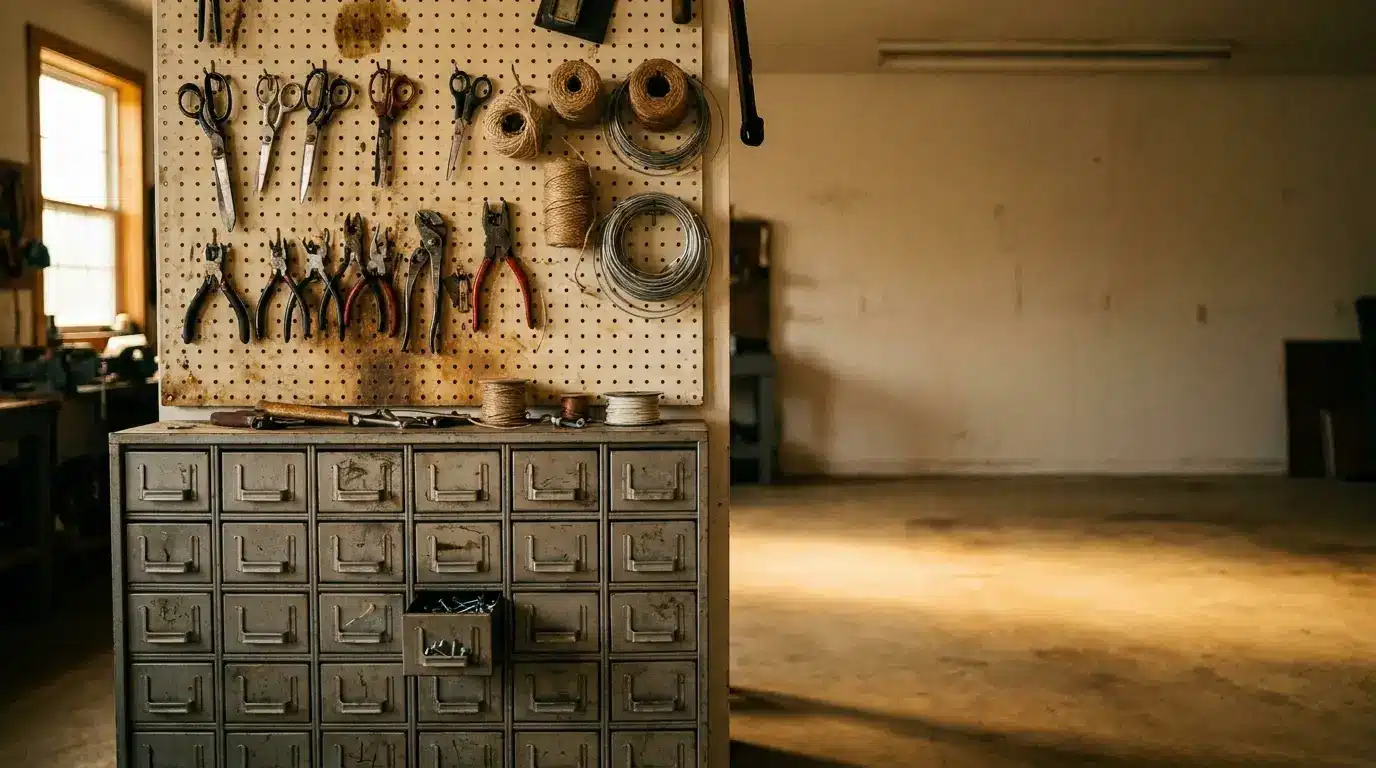
Typically, walls have more storage than the floor. Keep tools in sight with pegboard and slatwall, and move projects with a French cleat system. Beads, buttons, screws, and other small supplies stay sorted in a metal part storage cabinet with drawers and dividers.
- Put a word and picture on bins for younger children to put things back.
- Give each family member one “in progress” shelf.
- Avoid placing paper and fabric on bare concrete surfaces that may let moisture through.
Control Dust, Fumes, and Temperature
Most people don’t realize that craft materials release more into the air than they would think. Fine dust is generated when sanding, solvent vapor when spray painting and alcohol inks, and rosin fumes when soldering. When using these materials, open the garage door a few feet and use a window fan facing out. A Corsi-Rosenthal box (a 20-inch box fan with four MERV 13 furnace filters strapped around it) costs about $100 and effectively filters small particles.
A garage is the most difficult place to control temperature inside. Acrylic paints and glues become harder to work with in the cold, and most epoxy resins cure best at temperatures between 70°F and 80°F. A foam-panel garage door insulation kit costs $100 to $200 for a double door and can significantly reduce heat loss. A ductless mini-split heat pump works best for year-round use. Do not operate a motor vehicle or gas-powered equipment in any enclosed area where people are working, since carbon monoxide accumulates rapidly in a closed area.
Build Work Surfaces for Every Height
A typical adult workbench is 36 to 38 inches tall with the top at about the height of a young child’s chin. Children sit comfortably at tables from 22 to 26 inches tall, and adults need 28 to 30 inches. There is no universal “one size fits all” solution for one fixed surface.
For the most part, adjustable folding tables solve this. Lifetime’s 4′ adjustable tables are set at 24”, 29” and 36”, allowing a first grader to use the table in the afternoon, then have a parent cut fabric on it at night. Combine it with a wall-mounted bench for tools, a sturdy step stool, and anti-fatigue mats for adults standing on concrete for long periods. Cover paint and glue surfaces with a wipeable vinyl cloth or a sheet of hardboard that is changed annually.
Set Safety Rules Everyone Follows
Equipment is only a help if it’s within reach. Install an ABC fire extinguisher with a first aid kit by the exit. For a garage, consider installing a heat alarm instead of a smoke alarm, because dust and car exhaust can cause false smoke alarms. Mount ANSI Z87.1 safety glasses for adults and children in the tool area.
Repeated reminders are less effective than written rules. Post a short list at child eye level and go over it with each new user:
- Hot tools remain on a silicone mat and are unplugged after use.
- Power tools are only operated by an adult.
- Paint, glue and solvents are immediately replaced with lids.
- Each session includes 10 minutes of clean-up.
If you have children under 10, opt for the low-temperature glue guns, which operate at approximately 250°F, rather than the 380°F of regular glue guns.
Conclusion
A garage craft studio has to be built in phases, so first get the foundation of the floor plan and the electrical connections in place, as these are the most difficult to change later, and then add lighting, air control, adjustable tables, and tool storage. Inspect the space every six months as children grow and develop new interests, and last year’s table heights may no longer suit the users.