



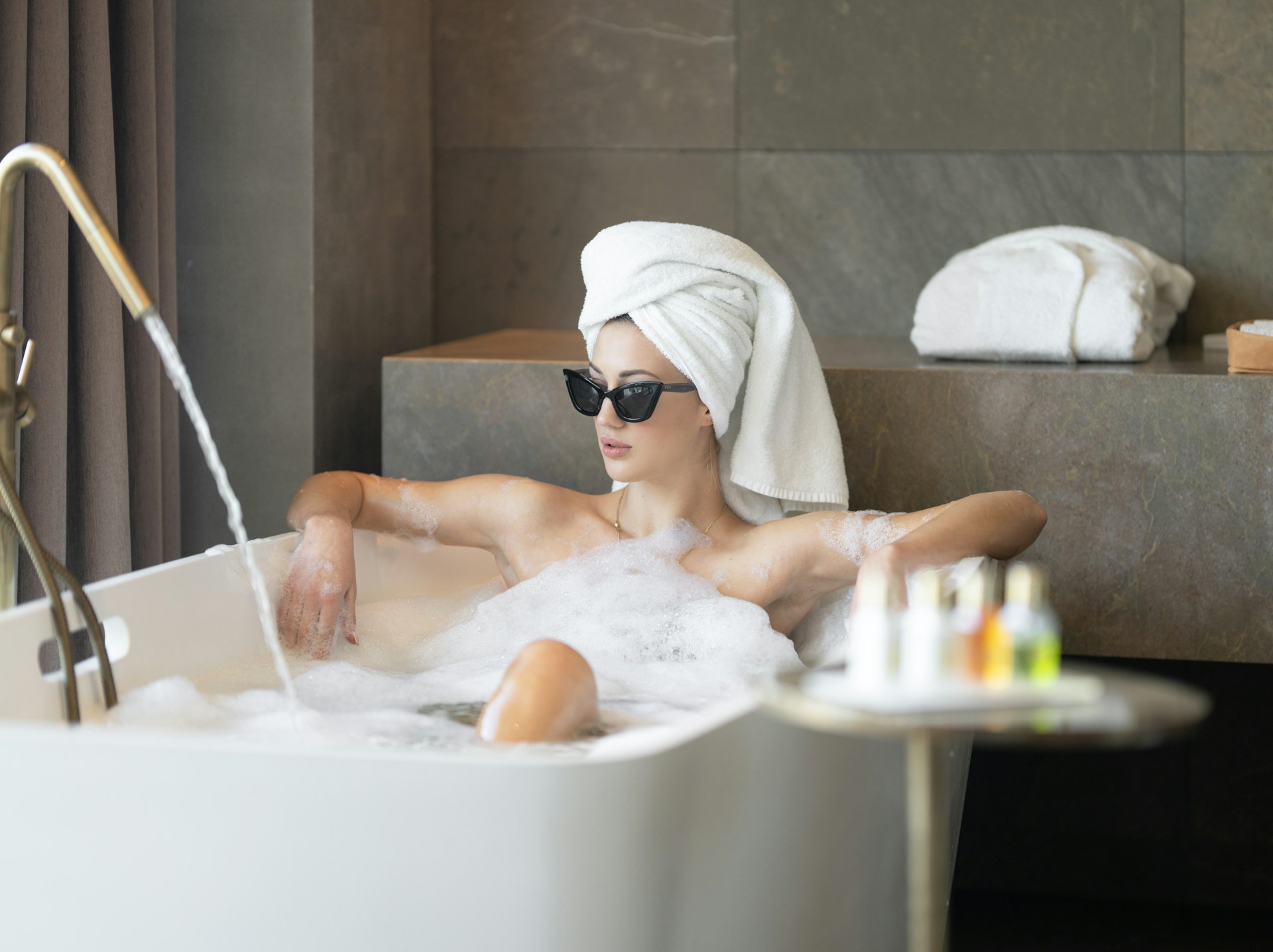
You know the feeling. Water so hot it takes three tries to get all the way in, and then forty minutes of bliss while the house is finally quiet.
And then you get out, dry off, and within twenty minutes your skin feels tight, itchy, and somehow drier than before you got in the tub.
That’s not in your head, and it’s not your moisturizer failing. It’s thermodynamics doing exactly what thermodynamics does, and once you understand the mechanism, you can keep the long soak and skip the aftermath.
Heat Dissolves the Thing Holding You Together
The outer layer of your skin is built like a brick wall. Cells are the bricks, lipids are the mortar – ceramides, cholesterol, fatty acids – and that mortar is what keeps water inside your body and irritants outside it.
Those lipids melt. Not dramatically, but measurably, and the hotter the water the more of them dissolve and float away down the drain. Anything above roughly body temperature starts pulling at them. Water that registers as “ahh, that’s hot” is usually sitting well past that point.
So you climb out with a barrier full of gaps. Water evaporates off your skin’s surface, and because the mortar is compromised, more water follows from underneath. That’s the tightness you feel at minute twenty. Your skin is losing water faster than it can hold onto it, and it started the moment you pulled the plug.
Warm, not hot. The difference between a bath that repairs and a bath that damages is about ten degrees.
Quick tip: if your skin is pink when you get out, the water was too hot. Flushing means the vessels dilated, and that’s your visual cue – no thermometer required.
The pH Problem
This one surprised me, and it matters more if you’re a DIY bath bomb person.
Healthy skin sits at a pH around 4.7 to 5.5 – slightly acidic, which is why it’s called the acid mantle. That acidity does real work. It keeps the enzymes that build your barrier functioning and makes the surface inhospitable to bacteria that would rather it were neutral.
Now consider what a bath bomb is made of. Sodium bicarbonate, which is to say baking soda, sitting at a pH around 8. Every homemade recipe on Pinterest is built on it, because the reaction with citric acid is the entire point of the fizz.
Drop enough into a tub and you’ve nudged the water alkaline. Your skin then spends the next several hours climbing back down to where it started, and during that climb the barrier isn’t working at full capacity.
Which doesn’t mean skip the bath bomb. It means the other ingredients need to be doing something useful enough to earn their place. Formulated CBD bath bombs like Prima’s Bath Gems pair the fizz with Epsom salt, magnesium, and botanical oils – the Unwind version leans on eucalyptus, lavender, and camphor – so there’s emollient content going into the water alongside the bicarbonate. Worth noting these are adult products, not something to put in a kid’s tub, and the camphor in particular is a reason to keep them separate from family bath night.
What Epsom Salt Does and Doesn’t Do
Since we’re being honest about mechanisms.
Epsom salt is magnesium sulfate, and the standard claim is that magnesium absorbs through your skin and eases sore muscles. The evidence for that crossing the skin barrier in meaningful amounts is considerably thinner than the marketing suggests.
What a warm salt bath genuinely does: the heat increases local blood flow, the buoyancy takes load off your joints and lower back, and twenty minutes horizontal with nothing to do drops your nervous system out of alert mode. Those are real effects with real mechanisms. They’re just not magnesium ones.
I’d rather know that than believe something tidier. The bath still works. It works for different reasons.
The Three Minutes That Fix Everything
The single highest-value thing in this entire piece.
Get out, pat – don’t rub – and apply something occlusive to skin that is still visibly damp, within about three minutes. You’re trapping the water that’s already sitting on and in your skin before evaporation takes it.
Wait ten minutes and you’re moisturizing a dry surface, which does a fraction of the work. Same product, same amount, completely different outcome, and the only variable is timing.
An unobvious one: turn on the bathroom fan after you’re dressed, not during. Running it while you soak pulls humid air out and speeds evaporation off your skin the second you stand up.
Keep the Ritual, Change Two Things
Twenty to thirty minutes is plenty. Beyond that you’re mostly waterlogging the outer layer, which feels soft and is the opposite of strong.
(Incidentally, the pruning on your fingertips isn’t water absorption at all – it’s a nerve-controlled vasoconstriction response, which is why it doesn’t happen in a finger with nerve damage. Your body is deliberately adding grip tread. Strange and true.)
So: cooler than feels indulgent, shorter than feels indulgent, and moisturize while you’re still damp. That’s the whole adjustment.
The bath was never the problem. The thermostat was.