


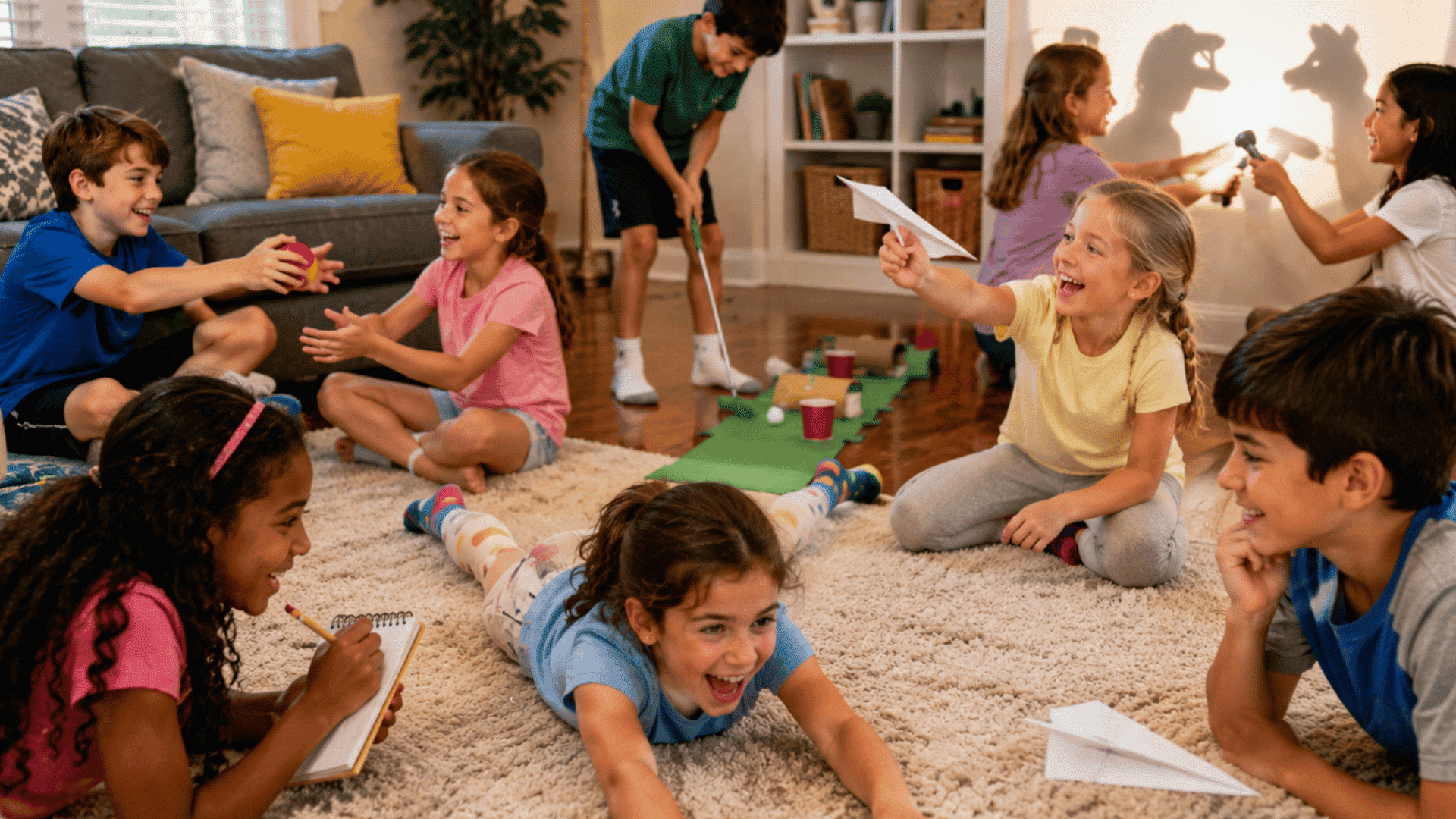
Rainy afternoons can test every parent’s creativity, especially when kids have energy to spare and screens have already taken up enough time.
I have found that simple games work best when the rules are clear, and children can start playing quickly. A good mix of active, quiet, creative, and cooperative options also keeps boredom from returning too soon.
This blog covers fun indoor games, setup tips, age ranges, group sizes, and benefits.
How Indoor Games Help Kids and Families Connect
Shared games bring families together, strengthening parent-child bonds and emotional regulation.
Younger children often enjoy quick, simple games like Simon Says, while nine- to twelve-year-olds prefer strategy, teamwork, and challenges that match their developing reasoning skills.
Getting that fit right is the difference between a game that lasts 40 minutes and one that’s abandoned in five. Pairing age-matched games with hands-on kids’ science experiments is another easy way to keep that curiosity going on long indoor days.
Space matters too; a solo child needs a different game than three siblings on a sugar rush. The best indoor games for 6-12-year-olds mix active, quiet, and group options, so something always fits the room and the mood.
Fun Indoor Games for 6–12-Year-Olds
The right indoor game can turn a boring afternoon into hours of fun.
If you are planning for a larger group or a birthday, these party games for kids give you more easy options for keeping everyone involved.
1. Indoor Treasure Hunt
A trail of hidden clues turns any living room into an expedition kids don’t want to end. Each note leads to the next, building suspense with every step. It works just as well for one child on a quiet afternoon as it does for a whole birthday crowd.
- Setup: Hide small notes or trinkets around the house, each pointing to the next spot
- Why kids love it: The suspense of the next clue keeps momentum going round after round
- Best for: Ages 6-12, rhyming riddles for younger kids and codes for older ones
2. Charades for Kids
Even the shyest kid usually cracks a laugh mid-performance in this one. Acting something out without a single word forces kids to get creative with their expressions. The guessing side gets just as loud and involved as the acting side.
- Setup: Write animals, movies, or actions on slips of paper for each player to act out
- Why kids love it: No talking required, so the giggles do all the work
- Best for: Ages 7-12, groups of three or more
3. Balloon Volleyball
A balloon changes everything: no bruises, no broken lamps, just slow-motion chaos. The floaty pace gives even the youngest player enough time to react. It turns a tiny living room into a full-on rally court.
- Setup: String yarn between two chairs and hand out a balloon as the “ball”
- Why kids love it: The floaty pace makes every save feel like a win
- Best for: Ages 6-10, small groups of two to six
4. Indoor Bowling
A hallway becomes a bowling lane in under two minutes flat. Knocking over a stack of bottles delivers the same thrill every single time. Scorekeeping adds a layer of friendly competition for older kids.
- Setup: Line up empty bottles or cups, then roll a soft ball down the hallway
- Why kids love it: Knocking things over never really gets old
- Best for: Ages 6-10; add point values for older kids who like keeping score
5. Simon Says
A classic for a reason: zero setup, instant fun, endless replay value. The trick lies in catching a command without the magic phrase attached. Even adults get caught out just as often as the kids do.
- Setup: One child gives commands starting with “Simon says,” and anyone who slips up is out
- Why kids love it: The trick-question thrill keeps everyone locked in
- Best for: Ages 6-9, groups of three or more
6. Pictionary
Bad drawings somehow make this game funnier, not worse. A ticking clock adds just enough pressure to turn simple sketches into frantic scribbles. Teammates shouting wrong guesses is half the entertainment.
- Setup: Split into teams, set a timer, and sketch a word while teammates shout guesses
- Why kids love it: The race against the clock adds just enough pressure to be fun
- Best for: Ages 8-12, groups of four or more
7. Freeze Dance
One second of silence can send a whole room into fits of giggles. Getting caught mid-move, arms flailing, is half the fun of this game. It burns off pent-up energy without needing much space at all.
- Setup: Play music, dance freely, then pause it without warning
- Why kids love it: Getting caught mid-move is half the entertainment
- Best for: Ages 6-9, works with just two players or a crowd
8. Musical Chairs
A party staple that never fails to spike the energy in a room. The scramble for a seat gets more dramatic with every round that passes. Fewer chairs means higher stakes and louder laughter.
- Setup: Circle chairs one fewer than the number of players and move to music until it stops
- Why kids love it: The scramble for a seat delivers instant, dramatic tension
- Best for: Ages 6-10, groups of four or more
9. Scavenger Hunt
Turning “find something red” into a mission makes kids see their own house differently. Every found item feels like a small personal victory. It sharpens observation skills without feeling like a chore.
- Setup: Hand over a list of household items or descriptive clues to track down
- Why kids love it: Every found item feels like a small victory
- Best for: Ages 6-12, solo or in groups of up to six
10. LEGO or Building Challenges
A time limit and a theme is all it takes to turn blocks into a real competition. Watching a wobbly tower survive, or collapse, is genuine suspense. It quietly teaches planning and patience without ever feeling like a lesson.
- Setup: Set a theme, like tallest tower or strongest bridge, and give a time limit
- Why kids love it: Watching a wobbly tower survive (or not) is pure suspense
- Best for: Ages 6-12, solo or small groups
11. Memory Games
Simple cards, surprisingly sharp focus, every single time. Catching a match after remembering a hidden card feels genuinely clever to a child. It’s portable enough to play anywhere in the house.
- Setup: Lay cards face down and take turns flipping matching pairs
- Why kids love it: Catching a match after remembering a hidden card feels genuinely clever
- Best for: Ages 6-11, solo or small groups
12. Indoor Obstacle Course
Couch cushions and painter’s tape make an obstacle course kids will beg to repeat. Beating a personal best time never stops feeling like a win. It’s an easy way to burn energy without leaving the living room.
- Setup: Build a crawl-jump-balance path using cushions, hula hoops, chairs, and tape
- Why kids love it: Beating a personal best time never stops feeling like a win
- Best for: Ages 6-12, solo or groups of up to six
13. Storytelling Games
One sentence at a time, the plot always spirals somewhere hilarious. No one knows where the story is headed, including the kids telling it. It works just as well on a couch as it does on a long car ride.
- Setup: One player starts a story with a line, and each player adds the next
- Why kids love it: No one knows where the story is headed, including the storytellers
- Best for: Ages 8-12, groups of two or more
14. The Floor Is Lava
Suddenly, the ordinary living room floor is completely off-limits. Kids have to think fast, move carefully, and find a safe route without touching the “lava.”
- Setup: Arrange cushions or sturdy floor markers as safe spots, leaving enough space to move between them
- Why kids love it: Every jump feels like a daring escape, especially when the safe route keeps changing
- Best for: Ages 6–12, two or more players
15. DIY Board Game Challenge
Designing the game turns out to be just as fun as playing it. Older kids get to be the boss of the rules for once, which is a novelty in itself. It blends art, logic, and storytelling into one satisfying project.
- Setup: Hand over poster board, dice, and markers to build a game from scratch
- Why kids love it: Older kids get to be the boss of the rules for once
- Best for: Ages 9-12, small groups of two to four
16. Hot Potato
A ticking sound and a passed object can turn any room into a burst of nervous giggles. The tension builds with every second the “potato” stays in a child’s hands. It’s over in seconds, so it’s easy to squeeze in one more round.
- Setup: Pass a small object around a circle while music plays, and pause it without warning
- Why kids love it: The countdown pressure makes even a quiet pass feel dramatic
- Best for: Ages 6-9, groups of four or more
17. Indoor Mini Golf
A hallway obstacle course suddenly feels like a real sports tournament. Cups, books, and paper towel rolls turn into makeshift holes and ramps. Keeping score adds a layer of friendly rivalry between rounds.
- Setup: Set up cups as holes and use household items as obstacles down a hallway
- Why kids love it: Sinking a tricky shot feels like a genuine sports win
- Best for: Ages 7-12, solo or small groups
18. Blindfold Drawing Challenge
Trying to draw something simple becomes surprisingly funny when kids cannot see the paper. The finished pictures rarely look as planned, making the big reveal the best part.
- Setup: Give each player paper and a marker, name something simple to draw, then have them draw while wearing a sleep mask
- Why kids love it: Revealing and comparing the unexpected drawings usually gets everyone laughing
- Best for: Ages 7–12, two or more players
19. Sock Sliding Race
Socks on a smooth floor turn hallway walking into an ice-skating rink. Kids race, spin, or freeze in place depending on the round’s rule. It burns energy fast without a single piece of equipment.
- Setup: Clear a smooth floor, put on socks, and race or spin from one end to the other
- Why kids love it: The slippery slide feels like a mini adventure every time
- Best for: Ages 6-10, groups of two or more
20. Would You Rather
Two tricky options and a room full of opinions make for surprisingly big laughs. Kids get to defend their pick, which sparks debates that go on far longer than expected. It needs zero setup and works anywhere in the house.
- Setup: Take turns reading out two options and have everyone pick a side
- Why kids love it: Defending a silly choice always turns into a fun little debate
- Best for: Ages 8-12, groups of two or more
21. Paper Airplane Contest
Folding, tweaking, and re-folding a plane teaches patience without anyone noticing. Distance and trick-shot rounds keep the competition fresh long after the first flight. Cleanup takes seconds since it’s just paper.
- Setup: Fold paper airplanes and take turns flying them for distance or accuracy
- Why kids love it: Watching a plane finally soar after failed attempts feels like a real triumph
- Best for: Ages 7-12, solo or small groups
Final Thoughts
Indoor play can make time at home feel more enjoyable, connected, and purposeful for children of different ages. The best choice depends on the available space, number of players, energy level, and supplies already on hand.
Active games help children move, while quieter activities support focus, creativity, and conversation. I recommend keeping a few flexible options ready so parents can quickly match the activity to the moment.
Rules can also be simplified for younger children or adjusted to challenge older siblings.
With a balanced mix of movement, teamwork, imagination, and calm play, families can reduce screen time and create shared moments that children genuinely enjoy.
Frequently Asked Questions
What Indoor Games Can One Child Play Alone?
Solo-friendly options include memory cards, building challenges, paper airplanes, puzzles, drawing games, shadow puppets, and homemade board games.
What Are the Best Indoor Games for Small Spaces?
For small spaces, try memory cards, charades, Pictionary, storytelling, shadow puppets, Simon Says, or a seated scavenger hunt with clues.
Which Indoor Games Help Kids Burn Energy?
Obstacle courses, freeze dance, balloon volleyball, Simon Says, sock sliding, and musical chairs help children move and release extra energy indoors.
What Are Good Noncompetitive Indoor Games for Kids?
Storytelling, cooperative building, shadow puppets, group drawing, treasure hunts, and shared craft projects keep attention on teamwork rather than winning.