





You spot a flash of silver in a child’s smile, and it is natural to wonder what happened to the tooth. Metal crowns can look surprising if you have never seen one before, especially on a young child.
Dentists use these crowns in certain situations when a baby tooth needs more protection than a smaller restoration can provide.
So, why do kids get silver teeth? This guide explains what the crowns are, why dentists recommend them, how placement works, available alternatives, aftercare, and when parents should call the dental office.
What Are Silver Teeth In Kids?
Silver teeth in kids usually refer to stainless steel crowns placed over damaged baby teeth. Dentists commonly use these metal caps when a tooth has a large cavity, is weak after treatment, or needs more protection than a filling can provide.
The crown covers the visible part of the tooth and helps restore its shape and function. It can also protect the tooth from further damage while your child chews and speaks normally.
These crowns are often used on back baby teeth because they are strong and durable. They usually stay in place until the baby tooth naturally falls out.
Important: A crown is not automatically needed for every cavity. The dentist considers the extent of decay, remaining tooth structure, pulp health, the child’s cavity risk, symptoms, and how long the baby tooth is expected to remain before recommending treatment. (AADP)
Reasons a Child May Need a Silver Crown
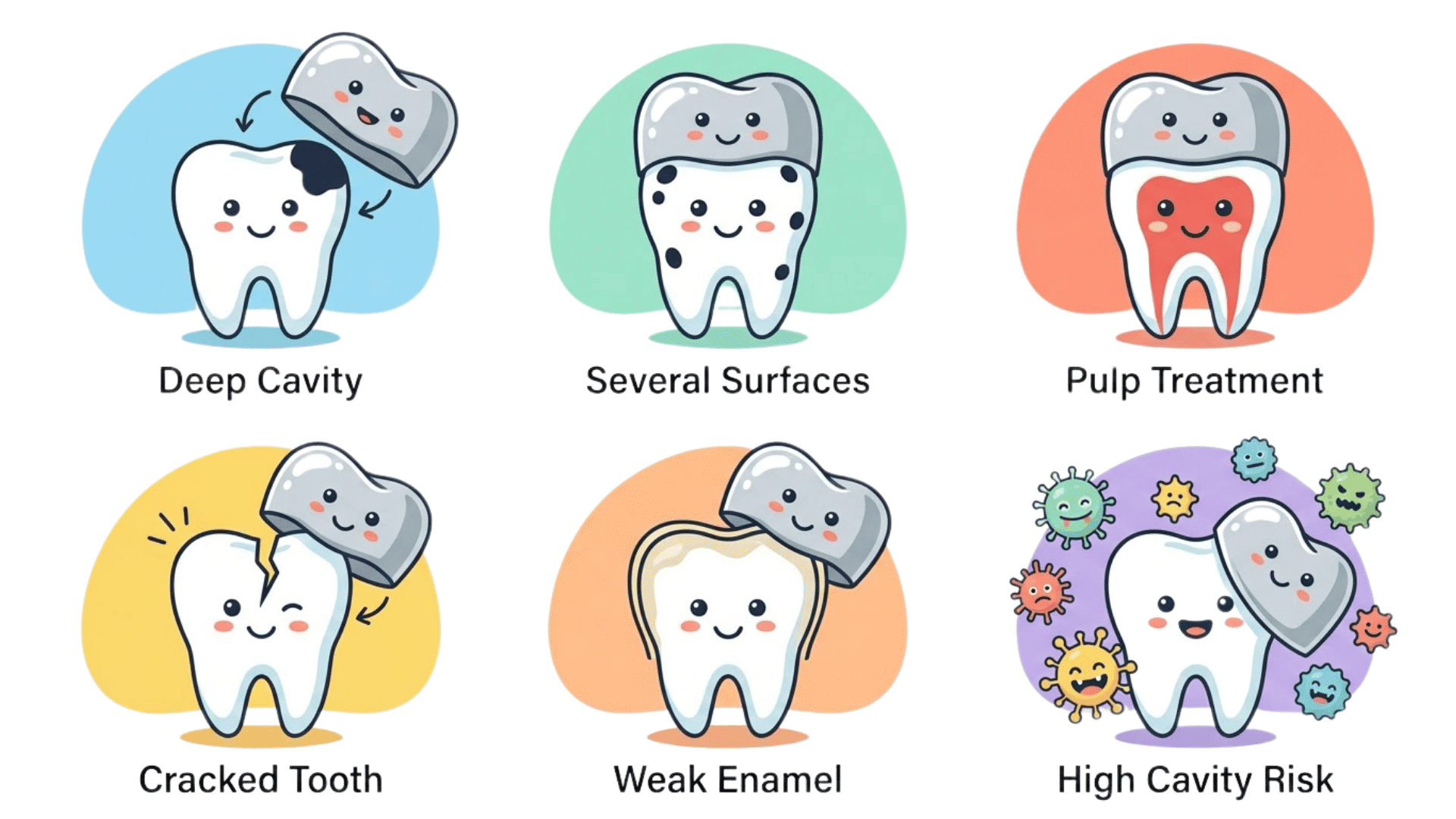
A silver crown may be recommended when a child’s tooth needs more support than a smaller restoration can provide. The decision depends on how much healthy structure remains and the treatment the tooth has already received.
The situations below (AAPD) explain when dentists may consider full coverage:
1. Large or Deep Cavities
Some cavities leave a baby tooth too weakened for a smaller restoration to work well. The amount and location of the damage help the dentist decide how much coverage is needed.
These points explain why a crown may be considered:
- Extensive decay: A large cavity can weaken too much of the tooth for a filling to work well.
- Limited structure: Less healthy tooth remains for a filling to bond securely.
- Full coverage: A crown surrounds the visible tooth instead of repairing only one spot.
- Common crown use: Preformed metal crowns are often used when decay is extensive, or other restorations may fail.
2. Decay on Several Tooth Surfaces
Damage can sometimes extend around more than one part of a baby tooth. In those cases, restoring separate areas may not give the tooth enough support.
The main considerations include:
- Multiple surfaces: Decay on several sides can make a standard filling less suitable.
- Greater coverage: A crown protects the full visible part of the tooth.
- Added strength: Full coverage can reduce the chance of a large restoration breaking down.
- Multisurface decay: This type of damage is a common reason dentists may choose a preformed metal crown.
3. Pulp Treatment
Treatment involving the inside of a baby tooth can leave the remaining structure needing extra protection. The dentist may therefore restore the tooth after the pulp procedure is complete.
- After pulpotomy: A crown may be placed after part of the affected pulp is removed.
- After pulpectomy: Full coverage may also follow treatment that removes more pulp tissue.
- Stronger protection: The crown helps protect the remaining tooth during everyday use.
- Post-treatment coverage: Preformed metal crowns are commonly used after pulp therapy in primary teeth.
4. Cracks or Dental Injuries
An injured baby tooth does not always need to be removed. Depending on the type of damage and the tooth’s condition, a dentist may consider a restoration that helps preserve it.
Important factors include:
- Fractured tooth: A crack can weaken the structure and make further damage more likely.
- Protective coverage: A crown may help hold and protect the remaining tooth.
- Tooth preservation: Treatment may allow the tooth to stay functional until it naturally falls out.
- Injury-related use: Fractured teeth are among the situations where a preformed metal crown may be considered.
5. Weak or Poorly Formed Enamel
Some baby teeth develop with enamel that does not provide the usual level of protection. These teeth can require a different restorative approach than teeth with normally formed enamel.
- Enamel hypoplasia: The enamel may be thinner or incompletely formed.
- Hypocalcification: The enamel may be softer and less resistant to damage.
- Extra protection: A crown can cover the tooth when the enamel cannot provide enough strength.
- Developmental defects: Weak enamel conditions are recognized reasons for using preformed metal crowns.
6. High Risk of More Cavities
Some children have a greater chance of developing new decay or experiencing problems with existing restorations. Dentists may factor that overall risk into the treatment plan.
- High cavity risk: A history of several cavities can influence the choice of restoration.
- Failed restorations: Repeated filling problems may make full coverage more practical.
- Fewer repeat procedures: A durable restoration may reduce the need for more treatment on the same tooth.
- Special treatment settings: Crowns may be considered when care is completed under sedation or general anesthesia.
- Higher-risk cases: Preformed metal crowns are often used when a child has a high risk of future decay.
Keep in mind: A crown repairs and protects the treated tooth, but it does not stop the disease process that caused the cavity. Brushing with fluoride toothpaste, diet habits, preventive dental care, and follow-up remain important. (AADP)
Silver Crowns vs. White Crowns
Parents often ask if their child has to leave with a silver tooth. The short answer is no, not always. Two main crown types are used in pediatric dentistry today, and each fits a different situation.
|
Factor |
Stainless Steel Crown |
Zirconia Crown |
|---|---|---|
|
Color |
Silver |
Tooth-colored |
|
Common placement |
Back baby teeth |
Front or visible teeth and some molars |
|
Tooth preparation |
Usually less reduction needed |
Often requires more tooth removal |
|
Adjustment |
Can be trimmed and crimped chairside |
Cannot be adjusted the same way |
|
Retention |
Strong, long clinical record |
Depends heavily on preparation and fit |
|
Cost |
Often lower |
Often higher |
|
Metal allergy concern |
Product composition must be checked |
Metal-free option |
Note: Zirconia offers a tooth-colored alternative when appearance is important. Studies report promising clinical results, but the evidence comparing zirconia directly with stainless steel crowns in primary molars remains limited, so the best choice depends on the tooth and clinical situation. (Find source here)
Why Is It Necessary to Save a Damaged Baby Tooth?
Saving a damaged baby tooth can help protect normal chewing, speech, and the space needed for the adult tooth underneath. Understanding when baby teeth naturally fall out can also help explain why dentists may try to preserve a damaged primary tooth rather than remove it too early.
Baby teeth may be temporary, but they still play an important role while a child grows.
If a damaged tooth can be repaired, keeping it in place may help nearby teeth stay properly positioned. It can also reduce problems with chewing on one side of the mouth.
Here’s What Happens During Crown Placement
Most stainless steel crowns are placed in a single dental visit. The process is straightforward once the dentist has reviewed the tooth and decided a crown is the right treatment.
- Examination and X-rays: The dentist fully examines the tooth and reviews X-rays to understand the extent of the damage before starting.
- Numbing the area: The tooth and surrounding gum are numbed with local anesthetic, if needed, to keep the child comfortable.
- Decay removal: All decay is cleaned out of the tooth before anything else is placed.
- Pulp treatment if needed: If decay has reached close to or into the nerve, a pulpotomy or pulpectomy is completed at this stage.
- Tooth shaping: The tooth is trimmed slightly so the crown fits over it without raising the bite.
- Crown selection and adjustment: The dentist picks the right size from a set of preformed crowns and adjusts the fit as needed.
- Cementing the crown: Dental cement holds the crown firmly in place over the prepared tooth.
- Final checks: The dentist tests the bite and examines the crown edges to confirm everything sits correctly.
Conventional stainless steel crown placement may be completed during one treatment visit, but appointment length and the number of visits vary with the tooth, treatment required, and the child’s individual needs.
Important Note: This describes conventional crown placement. In selected primary molars, a dentist may instead use the Hall technique, which involves cementing a preformed metal crown over the affected tooth without conventional drilling, caries removal, or tooth preparation. It is not appropriate for every tooth. AAPD currently supports the Hall technique as one minimally invasive treatment option in selected cases
Does Getting a Silver Tooth Hurt?
For most children, the procedure is manageable. Local anesthetic is used during conventional crown placement, so the child should feel pressure, not sharp pain, during the appointment.
Some mild gum soreness is normal in the hours after. It usually settles quickly.
Sedation is not automatically part of the process. if it is offered depends on the child’s age, anxiety level, health history, cooperation, and how much treatment is needed in one visit.
A dentist who handles why do kids get silver teeth questions regularly will walk parents through the comfort options before the appointment starts.
No outcome can be guaranteed, but most children tolerate crown placement without significant distress.
How Do Crown Filling and Extraction Differ
The right dental treatment depends on the condition of the tooth and how much work it needs. Each option affects the tooth differently.
The comparison below makes those key differences easier to understand at a glance:
|
Difference |
Crown |
Filling |
Extraction |
|---|---|---|---|
|
What it does |
Covers the tooth |
Repairs a damaged spot |
Removes the tooth |
|
Used for |
Large cavities or weak teeth |
Small to moderate cavities |
Teeth that cannot be saved |
|
Tooth kept |
Most of the tooth stays |
Nearly all healthy tooth stays |
Tooth is removed |
|
Strength after treatment |
Adds strong protection |
Restores the damaged area |
No tooth remains |
|
Common use |
Often back baby teeth |
Front or back teeth |
Any tooth if needed |
|
Main goal |
Protect and preserve |
Repair limited damage |
Remove severe damage |
|
How long it lasts |
Often until the baby tooth falls out |
May need repair later |
No restoration remains |
|
Aftercare |
Brush and clean normally |
Keep the filling area clean |
Allow the socket to heal |
|
Chewing afterward |
Usually returns to normal |
Usually returns to normal |
May feel different while healing |
|
Main benefit |
Protects a badly weakened tooth |
Less extensive treatment |
Removes a tooth that cannot be restored |
Are Silver Crowns Safe for Kids?
Stainless steel crowns have been used in pediatric dentistry for decades. They have a long clinical record and remain a standard treatment for badly damaged baby teeth.
One common concern worth clearing up: stainless steel crowns are not made from dental amalgam. They look silver, but the materials are different. These crowns contain no mercury.
That said, crown alloy composition does vary by manufacturer. Some products may contain nickel or other metals. Because of this, report any known metal allergy to the dentist before treatment starts.
This is one of the more practical answers to why kids ask about the safety of silver teeth.
For children with a confirmed metal allergy, zirconia crowns offer a metal-free alternative worth discussing with the dentist.
Daily Care Tips for a Child’s Dental Crown
Keeping the area healthy after treatment is mostly about consistent home habits and following the dentist’s specific directions. I’d keep the routine simple enough that it is easy to maintain every day.
Use the steps below once your child comes home with the crown (Find source here):
- Wait for numbness to fade: Let the anesthetic wear off before your child chews to reduce accidental cheek or tongue biting.
- Brush twice daily: Clean the crown with fluoride toothpaste just as you would the surrounding teeth.
- Clean the gumline: Brush carefully where the crown meets the gum to remove plaque buildup.
- Floss touching teeth: Floss daily wherever the crowned tooth contacts the tooth beside it.
- Limit sticky foods: Avoid sticky sweets that may cling around the crown and surrounding teeth.
- Keep dental checkups: Regular visits let the dentist monitor the crown and nearby teeth.
- Follow dentist instructions: Use any food, medicine, or care directions provided after treatment.
When Does the Silver Crown Come Out?
In most cases, the crown falls out with the baby tooth. No separate removal appointment is needed. Timing depends on which tooth received the crown, since different baby teeth shed at different ages.
This is one of the more reassuring answers to why kids get silver teeth. The crown is temporary by nature. It leaves when the tooth is ready.
If a crown becomes loose well before the tooth is due to shed, you need a dental visit. Do not try to glue it back at home.
If the crown comes out on its own, save it and call the dental office. The dentist will advise if it needs to be recemented or left alone.
Wrapping It Up
Seeing a silver crown in a child’s smile can raise plenty of questions, but the reason behind it is usually straightforward: the tooth needed stronger protection than a smaller restoration could provide.
The important part is that not every cavity, child, or baby tooth needs the same treatment. Tooth condition, cavity risk, symptoms, available crown options, and the child’s individual needs all matter.
If a dentist recommends a silver crown, ask what made it the preferred option, what alternatives are appropriate, and what care is needed afterward. Clear questions can make the treatment decision much easier to understand
Frequently Asked Questions
Can a Child With a Silver Crown Still Get Braces Later?
Yes. A silver crown on a baby tooth usually does not prevent future braces or orthodontic treatment.
Do Silver Crowns Affect the Permanent Tooth Growing Underneath?
Usually not. The crown covers the baby tooth and does not directly interfere with the permanent tooth developing below it.
Is the Hall Technique Different From a Standard Crown Placement?
Yes. The Hall technique can seal decay under a crown without drilling or removing the decay first in selected cases.
Can a Child Be Allergic to a Stainless Steel Crown Without Knowing?
Yes. An unknown metal sensitivity is possible, so tell the dentist about any past reactions to jewelry, buckles, or other metals.