


One day, my child was looking at me. Then they said “mama.” Suddenly, I was crying over one little word because it felt so special.
Then came the big question: When do kids start talking, and is my child on track?
Many parents worry about this. It often starts after a late-night internet search, leaving them feeling even more confused.
Before you start to worry, here’s what is normal, what may be a sign of concern, and what really matters when it comes to learning to talk.
When Do Kids Start Talking?
Most kids start talking between 12 and 18 months.
Before that, they communicate through coos, gurgles, and babbling. These early sounds are not random; they help build the brain pathways needed for speech.
Babies gradually move from making sounds to using gestures like pointing and then speaking their first words. Over time, single words turn into short phrases and eventually full conversations.
While every child develops at their own pace, these early stages form the foundation for language and communication.
Why is Talking a Critical Milestone in Every Child’s Development?
Learning to talk is one of the most important things a child does. It shapes how they think, connect, and grow. Speech doesn’t just happen; it builds over time, piece by piece.
Babies start with sounds, then move to words, and then to full sentences, and each stage is significant.
When children talk, they learn to name feelings, ask questions, and share ideas. This builds confidence; in fact, the link between language and kids’ self-talk is well established.
Talking also strengthens the brain. It grows vocabulary, sharpens memory, and lays the foundation for reading.
Children who talk more tend to do better in school later on. Language, simply put, opens every door.
Let’s Walk Through Every Stage of Development
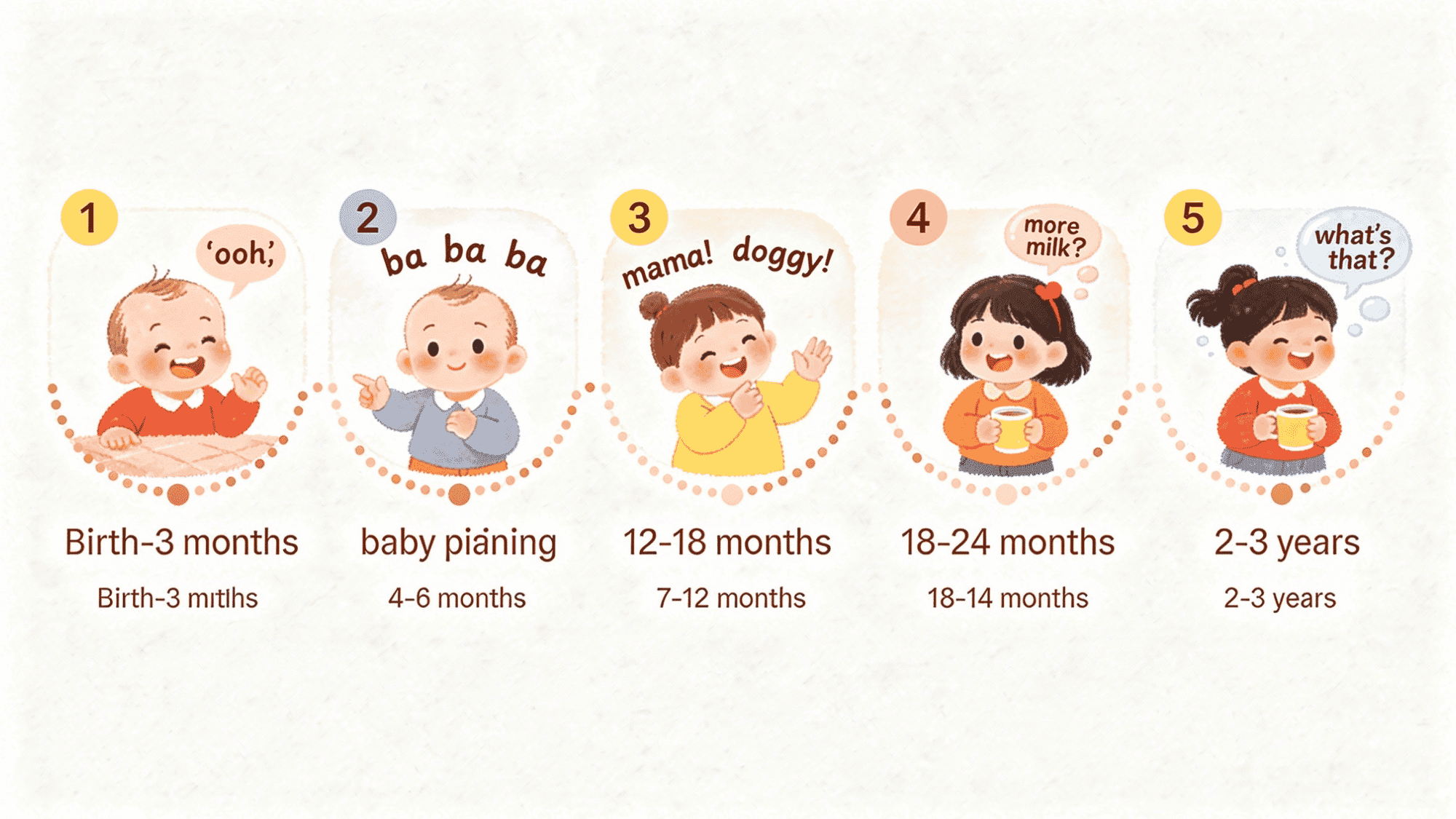
Speech doesn’t arrive all at once; it builds gradually, one sound at a time. Most parents focus on that first word, but the path starts much earlier.
Speech builds slowly, from a newborn’s first coo to a toddler’s full sentences. Understanding each stage helps parents know what’s normal:
Birth to 3 Months
Sometimes parents don’t realize speech development begins at birth, not at the first word. These early weeks are when the brain starts wiring itself for language.
Here’s what those very first signals of communication actually look like:
- Coos, gurgles, and makes soft vowel sounds like “ooh” and “aah.”
- Reacts to familiar voices, especially the mother’s
- Startles at sudden loud noises, showing active auditory processing
- Cries differently for hunger, pain, or tiredness, an early form of communication
- AAP confirms early vocalization directly predicts later speech outcomes
4 to 6 Months
Babbling kicks in, and the voice becomes a tool for exploration. This stage is louder, more playful, and more intentional.
Watch for these signs; real patterns are already forming:
- Babbles with consonant sounds: “ba,” “da,” “ga.”
- Responds to their own name consistently by 6 months
- Laughs and squeals to express emotion
- Matches facial expressions with sounds
- CDC Developmental Milestones (2022) flags no babbling by 6 months as an early red flag
7 to 12 Months
This is the stage parents ask about most: ‘Can one year olds talk?’ The short answer is yes, in a limited but meaningful way.
This is what intentional communication starts to look like right before that first birthday:
- Babbling becomes complex and sentence-like in rhythm
- Imitates sounds and simple words heard repeatedly
- Says first real words, “mama,” “dada,” “no” , around 9–12 months
- Points to objects to communicate wants
- CDC (2022) confirms that most children say 1–3 meaningful words by their first birthday
12 to 18 Months
Understanding ‘when do toddlers start talking’ starts here. This window is where intentional speech truly begins to take shape.
These are the milestones that tell you language is officially underway:
- Vocabulary grows to 10–25 words by 18 months
- Points to body parts or objects when named
- Understands far more words than they can say (receptive language lead)
- Uses words + gestures together to communicate
- ASHA states toddlers should use at least 10 words by 18 months, fewer warrants evaluation
18 to 24 Months
This is where language visibly accelerates. New words come almost daily, and two-word combinations begin to appear. Here’s what that vocabulary explosion actually looks like in real life:
- Vocabulary jumps to 50–200+ words
- Combines two words: “more milk,” “daddy go,” “no sleep.”
- Follows simple two-step instructions
- NIH NIDCD (2023) sets a 50-word vocabulary by age 2 as the standard clinical benchmark
- Preschooler sensory play is a great way to naturally encourage more words and interaction during this phase.
2 to 3 Years
By now, speech is unmistakably conversational. Sentences grow longer, questions multiply, and personality comes through in every word. This is what the final stretch of early speech development sounds like:
- Uses 3–4-word sentences regularly
- Asks constant “why,” “what,” and “who” questions
- Strangers can understand roughly 75% of speech by age 3
- Follows multi-step instructions with ease
- AAP (2022) notes that speech intelligibility below 50% at age 3 should be evaluated by a speech-language pathologist
What Real Parents Say About When Their Kids Started Talking?

Every parent’s experience with their child’s speech path is different, and often surprising. Some kids start talking early, others need a little more time, and both can be completely normal.
Here’s what real parents shared about ‘when do kids start talking’ in their homes:
“DS10 and DD6 were both speaking in full sentences by the time they were 2. DD14 on the other hand, didn’t speak more than one-syllable grunts until past his third birthday. He had some severe auditory processing difficulties and received speech therapy for a number of years.” -Source: DIS
“My daughter started talking with like mamma, papa from the age of 10 months.” -Source: FirstCry
“It depends on the environment the baby is growing up in. If you speak a lot of things around baby, definitely the child learns and tries to speak, not exact words but similar , at 1 year also. It totally depends on parents’ involvement with the child.” -Source: FirstCry
“You don’t have to wait for a pediatrician referral for an Early Intervention evaluation, anyone can refer a child. Pediatricians often take a ‘wait and see’ approach and don’t suggest evaluating until closer to age three, which can be a huge disservice to the child and family. Sometimes all it takes is a few months of EI for the child to catch up, especially if EI begins early.” -Source: DIS
“There IS harm in waiting. No one ever wants to believe there might be something wrong with their child, but it is best to err on the side of early intervention for the child. My daughter has autism. And guess who noticed the delays and signs first? Our daycare provider and friend.” – Source: DIS
Signs When You Need to See a Doctor
Speech delays are more common than most parents realize, and earlier action always leads to better outcomes. Knowing when kids start talking is one thing, but recognizing the warning signs is what truly matters.
Here are the key signs that tell you it’s time to stop waiting and see a doctor:
- No Babbling by 12 Months: Complete silence with zero sounds like “ba-ba” or “da-da” is a clear early red flag
- No Single Words by 16 Months: “Mama,” “dada,” or any object name should be present and used with intention by this age
- Fewer than 10 Words by 18 Months: This is a firm clinical benchmark set by ASHA, not a rough estimate
- No Two-Word Phrases by 24 Months: Simple combos like “more milk” or “daddy go” should be part of daily speech by age 2 (NIH NIDCD)
- Losing Words They Already Said: Any regression in speech at any age needs immediate medical attention, not a wait-and-see approach (AAP)
- Unintelligible Speech After Age 3: Strangers should understand 75% of your child’s speech by age 3; anything below that needs an SLP assessment
- Family History of Speech Delays: Always raise this proactively at well-child visits, even before any red flag appears
Conclusion
So now you have everything you need to know about when kids start talking, laid out stage by stage. Every child moves at their own pace.
That’s not a cliché. Some kids talk early, some talk late, and both can be completely fine.
But staying informed? That’s what I would suggest you focus on. Knowing the milestones, spotting the red flags early, and trusting your gut when something feels off- that’s what makes the real difference.
It’s what I’ve seen play out across the families I’ve worked with. The earlier a concern is addressed, the better the outcome. Sometimes it just needs a little time and the right support to find its way out.
Frequently Asked Questions
Is There a Difference Between a Speech Delay and a Language Delay?
Speech delay affects the clarity of pronunciation; language delay affects understanding and using words, two different conditions.
Do Boys Really Talk Later than Girls?
Yes, boys typically develop speech slightly later than girls, but both follow the same milestone timeline.
Does Being Bilingual Delay a Child’s Speech?
No, combined vocabulary across both languages is typically age-appropriate, even if each language seems limited.
One Response