





Co-parenting with a narcissist is a common concern among separated parents. However, the term is often used more broadly than its clinical meaning.
Difficult behavior does not always indicate narcissistic personality disorder, which only a qualified mental health professional can diagnose.
Knowing how to coparent with a narcissist means focusing on specific behavior, reducing conflict, setting firm boundaries, and protecting the child’s emotional well-being.
Disclaimer: This is for general information only and does not replace legal or mental health advice. Speak with a licensed attorney or mental health provider for guidance based on your situation.
What is a Narcissistic Personality?
According to the National Library of Medicine’s NCBI Bookshelf, Narcissistic Personality Disorder, or NPD, is a recognized mental health condition marked by grandiosity, a need for admiration, and low empathy.
A person with NPD may show an exaggerated sense of self-importance, entitlement, arrogance, difficulty accepting criticism, and little concern for other people’s feelings.
These traits can affect relationships, family life, and daily decisions, which is why co-parenting with a narcissist may involve repeated conflict, control, or blame.
Still, these behaviors do not confirm NPD. According to NCBI, diagnosis requires a persistent pattern across different settings and an assessment by a qualified professional.
Common Signs You’re Co-Parenting with a Narcissist
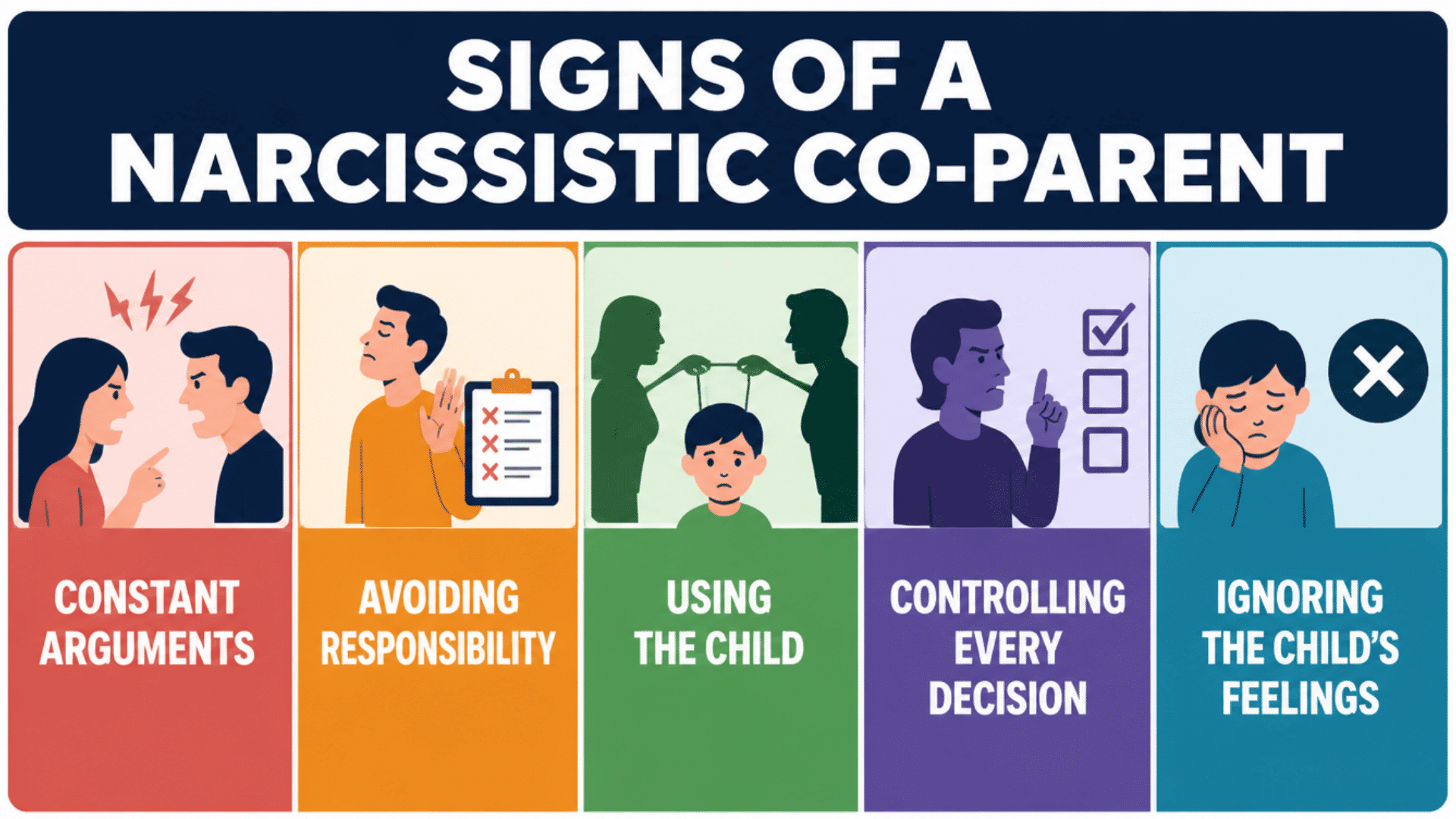
If your ex-partner shows repeated control, blame, and emotional pressure, it may create ongoing stress for both the parent and the child.
These patterns can influence much more than just schedules and communication:
- Every Discussion Becomes an Argument: Even simple parenting matters may turn into accusations, criticism, or personal attacks.
- They Avoid Responsibility: Missed exchanges, broken agreements, and parenting problems are often blamed on someone else.
- They Use the Child as a Messenger: The child may be asked to carry information, report on the other home, or take sides.
- They Try to Control Every Decision: They may reject reasonable requests, change plans without notice, or insist on having the final say.
- They Show Little Concern for the Child’s Feelings: Conflict may continue even when it causes anxiety, confusion, or emotional strain.
These patterns can cause lasting emotional stress, not just everyday parenting frustration. Learning how to coparent with a narcissist can help you set safer limits, reduce conflict, and create more stability for your child.
How to Co-Parent with a Narcissist: Must-Dos

Co-parenting with a narcissist requires clear legal boundaries, controlled communication, and decisions centered on the child’s well-being.
A structured approach can reduce recurring conflicts, protect important records, and create greater consistency across both households.
1. Understand Your State’s Custody Laws
The Families’ Rights and Responsibilities Act recognizes a parent’s right to their child’s upbringing, education, and health care, and emphasizes their responsibilities for caring for and raising children.
Key Steps:
- Confirm which parent has authority over education, health care, travel, and other major decisions.
- Review your state’s custody rules and compare them with the exact terms in the court order.
- Consult a family-law attorney before changing the schedule or responding to repeated violations.
However, S. 204 was introduced in the Senate on January 23, 2025, and is not itself a nationwide custody law. Custody arrangements remain largely controlled by state law and the terms of each family court order.
Tip: Keep the latest signed custody order nearby and follow its exact terms rather than relying on verbal agreements.
2. Create a Detailed Parenting Plan
A detailed parenting plan reduces disagreements by setting clear rules early. It outlines how parents handle time-sharing, exchanges, school, medical care, travel, communication, and expenses.
Key Steps:
- Set exact exchange times, locations, holiday schedules, and notice periods.
- State how major decisions about education, health care, and activities will be made.
- Include a clear process for schedule changes, reimbursements, and unresolved disagreements.
Clear wording leaves less room for conflicting interpretations and last-minute pressure. It also gives both parents a written reference when communication becomes tense.
Tip: Replace vague phrases such as “reasonable notice” with exact deadlines whenever state law and the court order allow.
3. Keep Communication in Writing
Written communication can reduce confusion and create a clear record of parenting discussions. It also gives you time to respond calmly rather than react during a tense phone call or in-person exchange.
Key Steps:
- Use email, text, or a court-approved application for important matters.
- Keep each message focused on one child-related issue.
- Save messages about schedules, expenses, school, health care, and missed exchanges.
Brief, factual messages are easier to review and less likely to turn into personal arguments. Written records may also help if a pattern of conflict or noncompliance needs to be discussed with an attorney.
Tip: Write every message as though a judge, mediator, or parenting coordinator may read it later.
4. Use Low-Conflict Communication Methods
Certain communication methods help you stay calm, avoid arguments, keep exchanges focused on the child, and avoid conflict.
Choose an approach that fits the message and use it consistently:
- BIFF Method: Keep replies brief, informative, friendly, and firm without responding to insults.
- Gray Rock Method: Use neutral, unemotional answers when the other parent tries to provoke a reaction.
- Yellow Rock Method: Stay polite and respectful while keeping the message factual and controlled.
These methods can reduce unnecessary back-and-forth, but they should still follow the parenting plan and court order.
Tip: Use BIFF for most written messages and save gray rock responses for communication that is clearly meant to trigger conflict.
5. Respond Only to the Parenting Issue
A hostile message may include blame, criticism, or unrelated accusations in response to one valid parenting question, focusing only on the part that requires a decision, an update, or a response regarding the child.
Key Steps:
- Ignore insults and comments that do not affect the parenting matter.
- Answer with dates, times, facts, and the requested action.
- Pause before replying if the message elicits a strong emotional reaction.
This approach can reduce unnecessary back-and-forth and keep communication centered on the child. It also helps create a clearer written record of your efforts to remain cooperative.
Tip: Remove any sentence that defends your character but does not help resolve the parenting issue.
6. Document Important Incidents
Accurate documentation reveals patterns such as missed exchanges, schedule changes, unpaid expenses, or hostility. Records should focus on what happened, when it happened, and how it affected parenting.
Key Steps:
- Record dates, times, locations, and direct statements.
- Save emails, text messages, receipts, school notices, and medical records.
- Keep notes factual and avoid guessing about the other parent’s motives.
Organized records can be useful when speaking with an attorney, mediator, therapist, or parenting coordinator. They may also help separate repeated behavior from one-time disagreements.
Tip: Write “the exchange began 45 minutes late” instead of using emotional labels or personal judgments.
7. Keep the Child Out of Adult Conflict
Children should not be asked to carry messages, report on the other household, or take sides between parents. Repeated exposure to adult conflict can affect their sense of safety and emotional stability.
Key Steps:
- Send all schedule changes, requests, and updates directly to the other parent.
- Avoid criticizing the co-parent in front of the child.
- Let the child share feelings without pressuring them for details.
Keeping adult issues between adults helps reduce guilt, confusion, and conflicts over loyalty. It also allows the child to maintain a relationship with each parent without feeling responsible for the disagreement.
Tip: Reassure the child that adult problems are not their fault and that they do not need to fix them.
8. Consider Parallel Parenting
Parallel parenting may work better when regular cooperation leads to repeated conflict or emotional pressure. It reduces direct contact while allowing each parent to manage routine matters during their own parenting time.
Key Steps:
- Limit communication to schedules, emergencies, and major decisions.
- Use fixed exchange times and neutral pickup locations.
- Follow the parenting plan rather than renegotiate minor issues.
This structure can reduce the number of arguments and provide the child with more predictable routines. It is often used in high-conflict cases where close coordination is not realistic.
Tip: Ask a family-law attorney whether communication rules, neutral exchanges, or a parenting coordinator can be added to the court order.
9. Maintain Predictable Routines
A steady routine can help the child feel more secure when communication between parents remains tense. Regular expectations around school, meals, sleep, homework, and activities can reduce stress and confusion.
Key Steps:
- Keep bedtime, meal, and school preparation times as consistent as possible.
- Explain schedule changes in simple, age-appropriate language.
- Avoid competing with the other household by giving gifts or relaxing rules.
Consistency at home gives the child a reliable structure, even when the other parent behaves unpredictably, focusing on stability rather than trying to control what happens in the other household.
Tip: Use a shared calendar for school events, medical appointments, and activities so important dates are easier to track.
10. Seek Legal and Mental Health Support
High-conflict co-parenting can affect sleep, concentration, mood, and daily functioning for both the parent and child.
Professional support can help address legal concerns, emotional strain, and safety issues before they become more serious.
Key Steps:
- Contact a family-law attorney when court orders are repeatedly ignored or misused.
- Speak with a licensed therapist if stress, anxiety, withdrawal, or behavior changes continue.
- Seek immediate help when threats, abuse, stalking, or child safety concerns are present.
Legal and mental health professionals serve different roles. An attorney can explain custody options, while a therapist can address the emotional effects of ongoing conflict.
Tip: Choose professionals with experience in high-conflict custody, coercive behavior, and child development.
What Experts Say About High-Conflict Co-Parenting
Some trusted community and professional websites share advice from licensed therapists, family-law professionals, and child development specialists.
These resources can help parents better understand co-parenting with a narcissist.
Their tips may offer useful ways to set boundaries, protect children from conflict, and manage communication. The expert insights below can support parents in learning how to co-parent with a narcissist.
“You cannot reason with a narcissist. They are terrible. That’s why special psychological strategies have been developed to deal with them, such as limiting contact with them, setting boundaries, and giving them minimal attention in order to protect yourself from their abuse.” – Dr. Julia PhD, Justanswer
“A narc simply can’t play nice for the kids like most exes, they need to seek supply. Conversations about such emotive subjects as your children are the best place for narcs to draw out reactions that feed their black hole.” – Jo Waugh, Quora
“Interventions must consider the four dimensions and their reciprocal interactions. The essential elements underlying parents’ difficulties may reside at a multiplicity of levels: inter-relational, contextual, and intrapsychic.” – NLM
Experts often recommend focusing on behavior rather than labels when co-parenting with a narcissist. Clear records, firm boundaries, and child-centered communication can help reduce repeated conflict.
Professional insight can also show how to co-parent with a narcissist without placing the child in the middle. The advice below covers legal planning, emotional safety, and healthier communication.
Can a Narcissistic Person Be Treated?

PMC, NLM states that Narcissistic Personality Disorder is considered relatively uncommon and rare, and there is no established cure that works for every person.
Psychotherapy is the main treatment and may help someone recognize harmful patterns, manage reactions, and improve relationships over time.
Progress often depends on the person’s willingness to accept help, remain in treatment, and take responsibility for their behavior.
Wrapping it Up
Managing a high-conflict co-parent requires patience, structure, and careful judgment. Focus on what you can control and keep the child’s needs at the center of every decision.
Seek legal or mental health support when the situation affects safety, daily functioning, or emotional well-being.
For co-parenting with a narcissist, the most practical approach is usually to focus on boundaries, legal support, written communication, and the child’s emotional well-being.
Frequently Asked Questions
Can a Narcissistic Co-Parent Change?
Change is possible, but it usually requires self-awareness, consistent therapy, and a genuine willingness to take responsibility.
Should I Tell My Child their Other Parent is a Narcissist?
Avoid using diagnostic labels with the child; instead, discuss specific behavior in age-appropriate language and provide emotional reassurance.
Can a Court Diagnose a Parent with NPD?
A family court does not usually make a clinical diagnosis, but it may consider evaluations, documented conduct, and the effect of behavior on the child.