

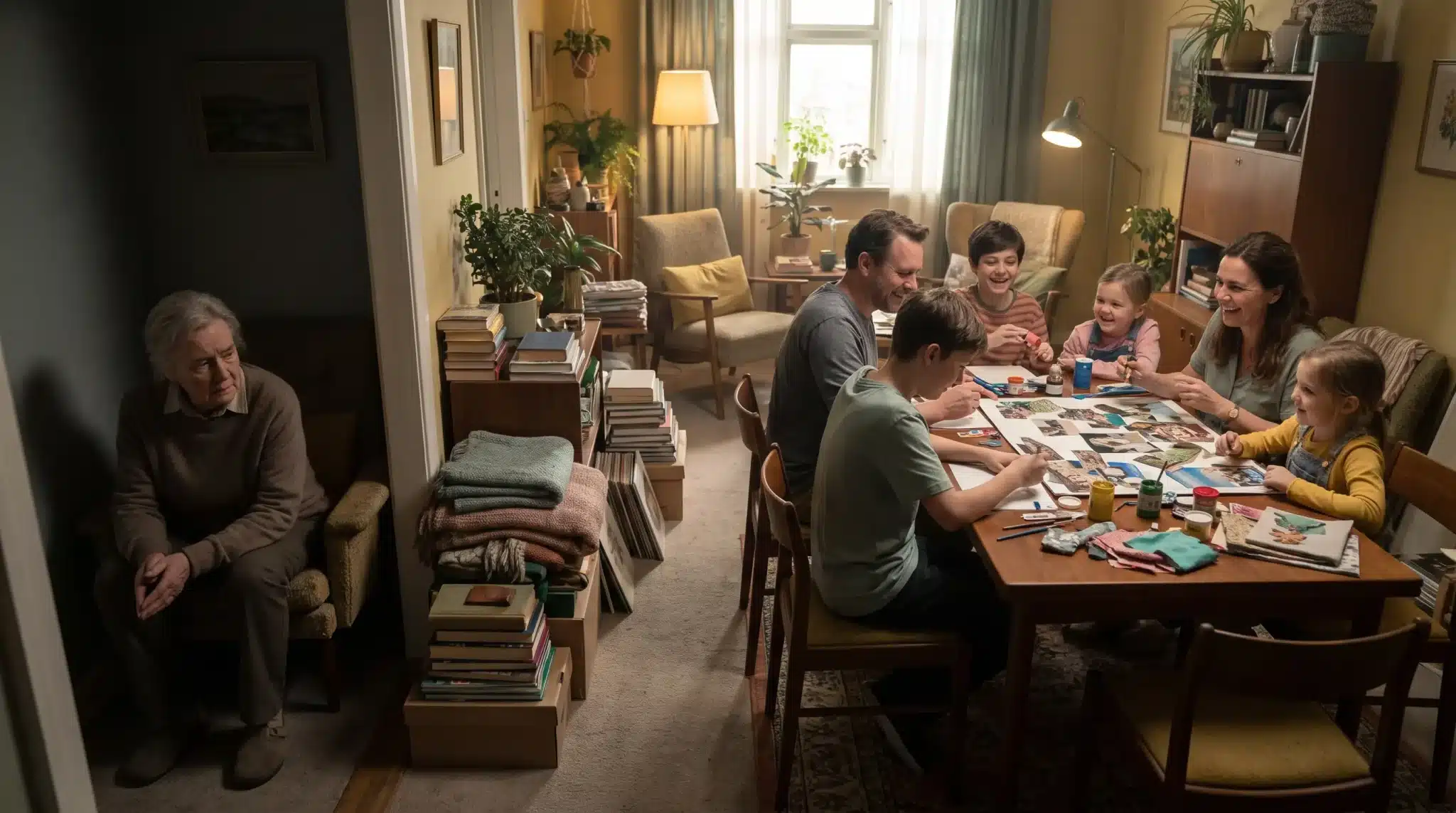
At Occasionally Crafty, most of our projects are built around family tables, craft nooks, and shared living rooms where kids and parents create together. But those same spaces often include grandparents, aging parents, or older relatives who move in for a season or a lifetime. When a household starts planning craft time, puzzle nights, or gardening projects for three generations, the room itself needs to work for everyone in it, not just the youngest hands at the table.
A lot of families assume that if an older relative can still walk around the house, the space is automatically usable for hobbies and activities. That assumption is where things go wrong.
A room can look perfectly normal and still be full of small setup mistakes that make knitting, painting, gardening, or even watching a movie together needlessly difficult for someone with limited mobility, weaker grip strength, or slower reflexes.
This matters more than most people realize. Many families researching this topic land on guides like 22 indoor activities for seniors, looking for fresh ideas to keep an aging parent engaged indoors. The activities are rarely the hard part. The hard part is the room those activities happen in. Below are four setup mistakes we see repeatedly, along with practical fixes that do not require a full remodel.
Mistake 1: Poor Lighting and Fall Hazards
Dim, uneven lighting is one of the most overlooked problems in homes with older adults. A living room that feels cozy to a thirty-year-old can feel genuinely dangerous to someone with reduced vision or slower depth perception.
Shadows near doorways, a single overhead bulb in a craft room, or lamps positioned behind the activity chair instead of beside it all make fine motor tasks like threading a needle or reading recipe cards far harder than they need to be.
Worse, poor lighting contributes directly to falls, and the bedroom, stairs, and bathroom remain the three most common locations where older adults suffer injurious falls, according to 2025 data from WesleyLife.
The fix is layered lighting rather than a single light source. A bright overhead fixture handles general visibility, a task lamp positioned at the activity table handles close work, and small plug-in night lights along hallways and near stairs handle transitions between rooms. Motion-sensor lights are especially useful in bathrooms and hallways, since they remove the need to fumble for a switch in the dark. None of this requires an electrician in most cases, just a willingness to rethink where light actually falls versus where it looks nice.
Mistake 2: Cluttered Pathways and Tripping Hazards
Craft supplies, seasonal decorations, extra furniture, and stacks of magazines tend to accumulate in family homes, and nobody notices the slow buildup until someone trips over it. For a fast-moving kid, a shoe left in the hallway is a minor annoyance.
For an aging relative using a cane or walker, or simply dealing with less stable balance, that same shoe can cause a fall. Pathways that seemed fine six months ago often narrow gradually as boxes, furniture, and hobby supplies pile up along the walls.
The most effective fix is a walkthrough audit rather than a general tidy-up. Walk the actual route an older family member takes from bedroom to bathroom, and from living room to kitchen, and remove anything within arm’s reach of that path, including throw rugs that bunch up or slide.
Cords should be secured against baseboards instead of stretched across floors, and any furniture that juts into a walkway should be moved even if it means losing a bit of surface space. Clear floors matter more for safety than a fully decorated room, and that tradeoff is worth making deliberately rather than by accident.
Mistake 3: Inaccessible Furniture and Activity Spaces
Standard dining chairs and coffee tables are designed for average adult mobility, not for someone managing arthritis, joint replacements, or general stiffness.
A chair that is too low forces strain on the knees and hips just to sit down or stand up, which discourages an older relative from joining craft time or card games at all. Similarly, tables that are too high or too low make repetitive tasks like knitting, painting, or assembling puzzles uncomfortable within minutes, even if the activity itself is enjoyable.
Ergonomic fixes here are usually simple and affordable. Chairs with firm cushions, sturdy armrests, and a seat height that keeps knees at roughly a ninety degree angle make sitting and rising far easier. Adjustable-height tables, or even a lap desk for activities done from a recliner, remove the need to hunch or stretch.
Horticultural and handicraft activities in particular have been shown to meaningfully reduce depression and improve physical, mental, and social wellbeing in older adults, according to a 2025 NCBI review, which makes it worth investing a little extra thought into making those specific activity spaces genuinely comfortable rather than merely available.
Mistake 4: Narrow Doorways and Room Transitions
Many homes built decades ago were never designed with wheelchairs, walkers, or wide-turning mobility aids in mind, and standard doorways can be too narrow to comfortably accommodate them.
This becomes a quiet form of isolation, since an older relative may simply stop trying to join activities in another room if getting through the doorway is a struggle every single time. Thresholds with even a small lip, and doors that swing the wrong direction for the available space, compound the problem further.
Widening solutions do not always mean structural changes. Swing-clear hinges can add two to three inches of usable doorway width without touching the wall, and removing a door entirely in favor of a curtain or pocket door often solves the problem outright in hallways.
Threshold ramps, available as low-cost rubber or wood inserts, smooth out the small elevation changes that trip up walkers and wheelchair wheels alike. Given that only about 10 percent of American homes are currently set up to support aging in place according to Census Bureau figures cited by Carex, these small transition fixes matter more than most families initially assume.
| Statistic | Figure |
|---|---|
| Seniors preferring to age in place | 77% of Americans over 50 |
| Homes ready for aging in place | Only 10% of American homes |
| Most common fall locations | Bedroom, stairs, bathroom |
| Older adults in outdoor activities (2024) | 23.1 million, up 1.6 million from 2023 |
According to Assisted Living, as of August 2022, 77 percent of Americans over the age of 50 preferred to age in place rather than moving elsewhere, yet most homes still lack the accessibility modifications needed to support safe indoor activities and independent living.
That gap between preference and preparedness is exactly why small setup mistakes carry so much weight. Fixing lighting, clearing pathways, adjusting furniture, and widening doorways will not turn a home into a medical facility, and it should not need to.
These are modest, achievable changes that let an aging family member keep doing the crafts, games, and hobbies that matter to them, in the same rooms the rest of the family already gathers in.