


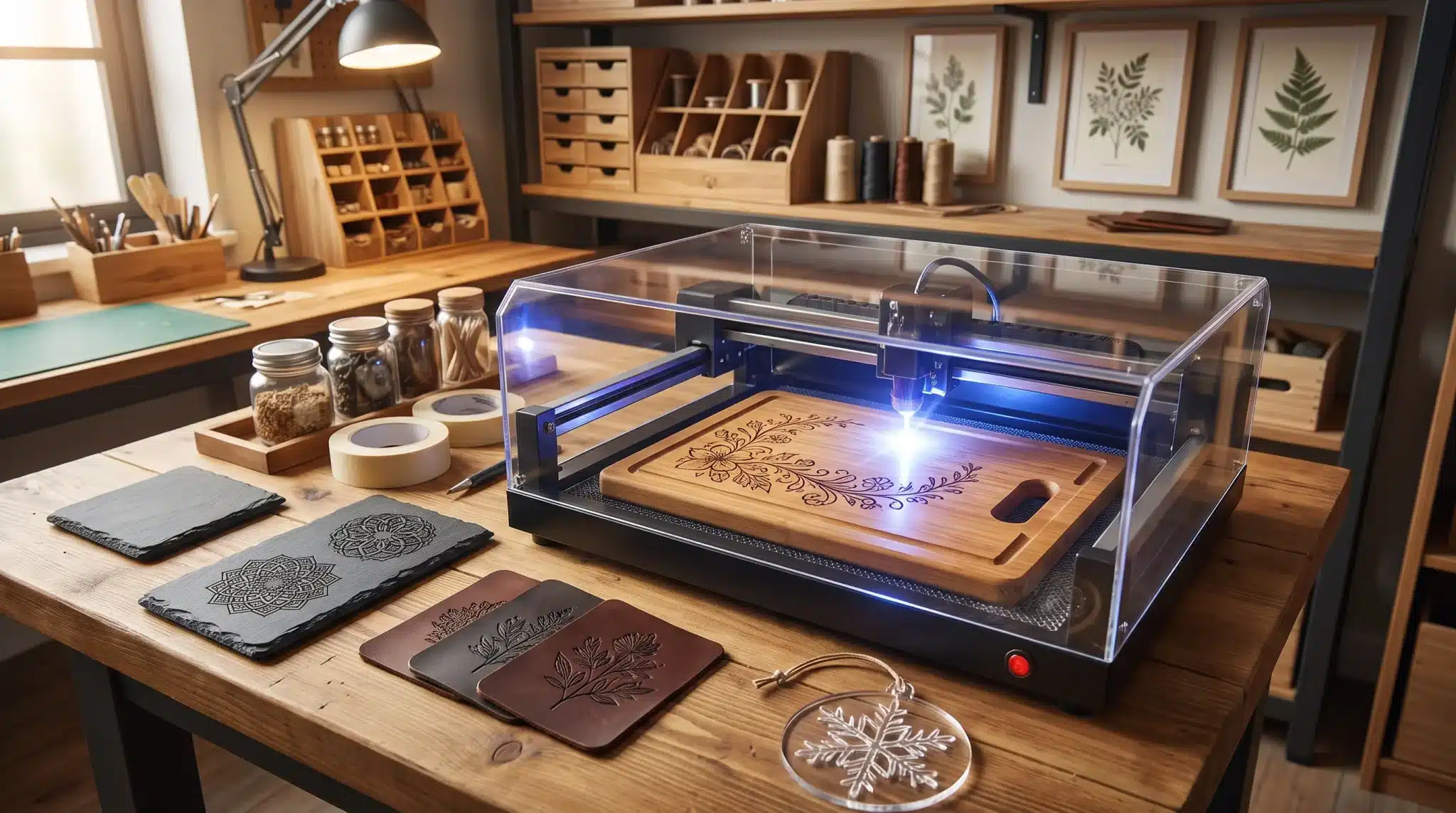
A lot of home crafters make the mistake of thinking that laser engravers are commercial-scale machines for business use. In reality, a home workshop might be one of the best places for one of these machines to live.
The good thing about using a laser engraver for your home crafts is that it bridges the gap between digital precision and hands-on making, letting you turn a design on your screen into a finished object in minutes.
Whether you’re a hobbyist woodworker, an artist, or just someone who loves a good DIY project, a laser engraver can open up techniques, materials, and ideas you probably haven’t tried yet. Here are five reasons to think about adding one to your setup.
1. A Laser Engraver Gives You Extreme Material Versatility
What are you working with these days? Laser engravers, especially diode and CO2 models, let you branch out into a huge range of materials. Wood, leather, acrylic, cardboard, slate, glass, even powder-coated metal tumblers- all with the same machine.
That’s a big deal, because it means one laser can replace a whole shelf of specialized tools. No more wood burner for pyrography, separate leather stamping kit, and glass-etching cream for tumblers- just one machine, with way more precision and consistency than doing it all by hand.
2. It Helps You Skip the Steep Learning Curve
With a laser engraver, you can pull off intricate inlays, precise typography, and complex geometric designs that would normally take years of carving or scroll-saw practice to master. Take a wood inlay pattern, for instance.
Normally that’s a steady-hand, fine-chisel, lots-of-trial-and-error kind of project. With a laser, you design it digitally and burn it in with consistent depth and clean edges every single time. So even as a beginner, you can produce work that looks like it came from someone with years of experience; the machine handles the technical execution, you handle the design.
3. They’re Perfect for Workshop Templates and Jigs
Here’s something people don’t always think about: a laser engraver isn’t just for finished pieces. It’s also great for making the tools behind your other projects. Woodworkers do this all the time: they use their laser to cut precise 1/4″ plywood or acrylic router templates and stencils.
Cut the shape, tack it onto your lumber, and route the same profile perfectly every time. No more freehand tracing or cuts that come out slightly different each time. Sewists and leatherworkers do something similar: a laser-cut acrylic template means every pattern piece comes out identical.
4. They’re Great for Customization and Personal Gifts
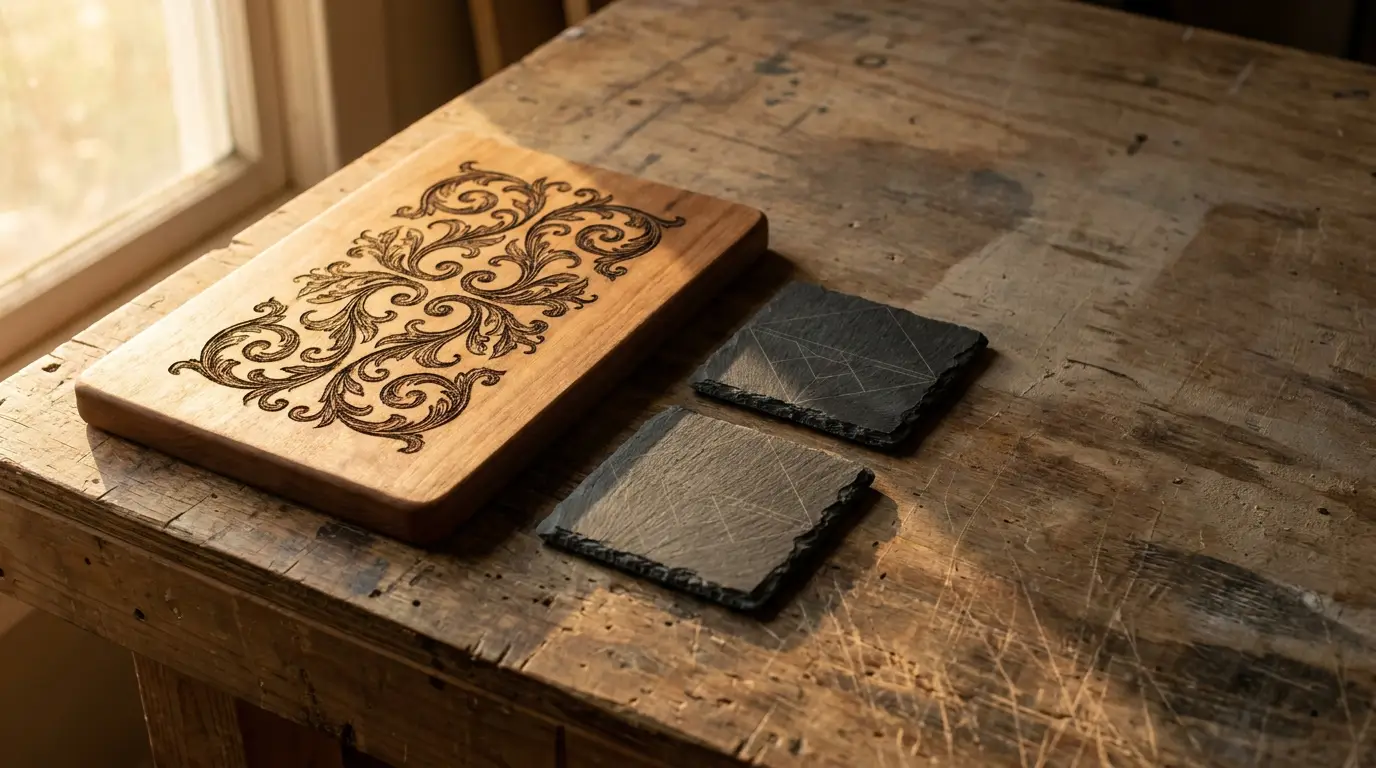
A laser engraver turns plain blanks into keepsakes people actually want to keep. Crafters use theirs for custom home organization boxes, personalized coasters, holiday ornaments, one-of-a-kind gifts, you name it.
Picture a plain wooden cutting board turned into a wedding gift with the couple’s names and date engraved across it, or a set of blank slate coasters becoming a matching housewarming gift with a family monogram. These are the small, high-impact projects that make people feel like the machine paid for itself after just a few uses.
5. You Can Prototype Ideas Fast
Got an idea for a physical object or structure? You can test it out fast and cheap using corrugated cardboard or foam board before you commit to pricier materials. This is especially handy if you’re designing boxes, enclosures, or anything with multiple pieces that need to fit together.
Cut a full-scale mockup in cardboard, check that the joints and dimensions actually work, and only move to hardwood or acrylic once you know the design is solid. It’s basically the same rapid-prototyping mindset 3D printing enthusiasts use, just applied to flat-pack, cut-based designs.
So, What Kind of Laser Engraver Do You Actually Need?
Unless you’re planning to run a laser business around the clock, a 10-watt to 20-watt diode laser or a 40W CO2 laser is a solid entry point. Diode lasers are appealing for home crafts because they’re affordable, compact, and work well for hobbyists dealing with organic materials like wood and leather. But there are two catches to going the diode route for home use: safety and scalability.
- Safety first. There are a lot of low-quality diode machines out there, and it’s genuinely hard to tell which ones will actually hold up. In the race to cut prices, plenty of brands cut corners on components too. For something running in your home, that’s not a risk worth taking.
- And then there’s scalability. Here’s a fact of laser engraving life: the moment you get comfortable with the basics, your brain immediately starts dreaming up bigger, more ambitious projects. Diode lasers tend to hit their ceiling pretty fast once that happens.
Why Choose a Desktop CO2 Laser For Home Crafts?
That’s where entry-level CO2 desktop engravers come in. They usually run from 40W to about 55W, and while they cost more upfront, you get a lot more versatility, plus, crucially, they come fully enclosed with Class 1 safety.
Much safer for a home setup. If you want something simple, portable, affordable, and reliable, the OMTech K40+45W Desktop Laser Engraver is worth a look. It strikes a nice balance between versatility and safety for home use. A few highlights:
- Engraving speed up to 300 mm/s, so you get better efficiency without sacrificing accuracy. Even if you eventually turn this into a side hustle, you likely won’t outgrow it.
- A 300 x 200mm (12″ x 8″) engraving area with manual focus height adjustment is easy to pick up whether you’re a hobbyist, a craft maker, or running a small makerspace.
A Couple of Rules of Thumb Before You Buy a Laser Engraver for Crafts
- Skip open-frame lasers for indoor use. Engraving wood, leather, or acrylic kicks off toxic, seriously unpleasant fumes. Go with a fully enclosed (Class 1 safety) machine and pair it with an exhaust system vented out a window. The enclosure also protects your eyes and your pets’ eyes from stray laser reflections.
- Learn LightBurn early. LightBurn is the gold standard software for designing and controlling your laser. Don’t bother getting comfortable with whatever clunky proprietary software comes bundled with a budget machine; just start with LightBurn from day one. Future-you will be grateful.
Final Thoughts on Choosing a Laser Engraver for Home Crafts
A laser engraver isn’t just a tool for pros; it might be one of the best additions you can make to a home craft space. From working across dozens of materials to knocking out precise templates, personalized gifts, and fast prototypes, it opens up a world of projects that would otherwise take years to master by hand.
The trick is picking the right machine for where you’re starting: a diode laser if you’re just testing the waters with organic materials, or an enclosed CO2 machine like the OMTech K40+ if you want the safety and headroom to grow into bigger projects down the road.

