






How Many Years of College Do You Need to Attend to Become a Hairstylist?
The question sounds as if becoming a hairstylist must begin with a college calendar: enroll in the fall, collect credits, and graduate several years later. In the United States, that is usually the wrong calendar. Most hairstylists need occupational training and a state license, not a traditional college degree. The process is commonly measured in training hours rather than academic years.
So, how many years of college to become a hairstylist? Usually none. A candidate generally completes a state-approved cosmetology or hairstyling program, passes the required licensing examination, and applies for a license. Depending on the state, school schedule, and type of license, training may take roughly nine months to two years. Full-time students often finish sooner than part-time students.
That distinction matters because “college” is used loosely. A community college may operate a cosmetology program, but the credential is often a certificate or diploma rather than an associate or bachelor’s degree. The U.S. Bureau of Labor Statistics classifies the typical entry-level education for barbers, hairstylists, and cosmetologists as a postsecondary nondegree award. It also reports that every state requires these professionals to be licensed.
College Degree and Cosmetology Training Are Not the Same
A future stylist does need education. It is simply a different kind of education, with more time spent at a shampoo bowl or styling station than in a lecture hall. Students study haircutting, color theory, chemical services, sanitation, client consultation, scalp and hair analysis, and state law. They also practice under supervision.
The academic side should not be dismissed. Students may have written assignments, theory exams, sanitation rules, and technical vocabulary to master alongside practical work. EssayPay connects students with qualified writers when they need academic guidance, although each student remains responsible for understanding the safety rules and techniques required in professional practice.
This is the clearest response to do you need a college degree to be a hairstylist: no, not in the conventional sense. A degree in business, marketing, or communications may help someone who plans to manage or own a salon, but it is not the standard credential used to qualify for an entry-level hairstyling license.
How Long Does It Take to Become a Hairstylist?
There is no honest national answer expressed as one fixed number. Licensing belongs largely to the states, and states set different education, examination, age, and application rules. A student’s weekly timetable matters too. Completing 1,000 hours at 30 hours per week is a different experience from completing the same requirement during evenings and weekends.
Students juggling technical classes with general education courses sometimes seek help with academic papers for students to manage the written side of their workload. Time management still matters in the practical program because attendance and completed training hours can determine when a student becomes eligible for the licensing exam.
For anyone asking how long does it take to become a hairstylist, these are reasonable planning ranges rather than guarantees:
|
Training route |
Typical planning range |
What can change the timeline |
|
Full-time certificate or diploma |
About 9 to 18 months |
State hours, school calendar, absences |
|
Part-time cosmetology program |
About 18 months to 2 years or longer |
Weekly schedule and course availability |
|
Community-college associate program |
Around 2 years |
General education and degree requirements |
|
State-approved apprenticeship |
Often longer than school training |
Required work hours and state rules |
The cosmetology school program length should therefore be checked in hours, weeks, and expected completion dates. A school advertising a “one-year program” may include breaks or require a pace that is hard to combine with employment. Another school may offer the same licensing preparation over a longer period with evening classes.
Why State Requirements Change the Answer
The phrase hairstylist education requirements can refer to several separate conditions: prior schooling, professional training, examinations, and licensing paperwork. Applicants should check each one instead of assuming that graduation from a beauty school automatically authorizes them to work.
Current state rules illustrate the variation. Texas requires 1,000 hours of instruction for a cosmetology operator license. New York also lists a 1,000-hour approved course for its cosmetology licensing route. Other jurisdictions may define the occupation differently or offer narrower licenses for hair-only services. Requirements can change, so the licensing board in the state where a person intends to work is the final authority.
A typical route looks simple on paper:
- Confirm the exact license category for the services the person wants to provide.
- Compare state-approved schools or approved apprenticeship options.
- Complete the required theory and supervised practical hours.
- Pass the written examination and any practical or oral assessment required by the state.
- Submit the license application, documentation, and fee.
The first step is easy to overlook. “Hairstylist,” “cosmetologist,” and “barber” do not always mean the same thing under state law. A broad cosmetology license may cover hair plus other personal-care services, while a specialized credential may have a narrower scope and a different hour requirement.
School, Apprenticeship, or Associate Degree?
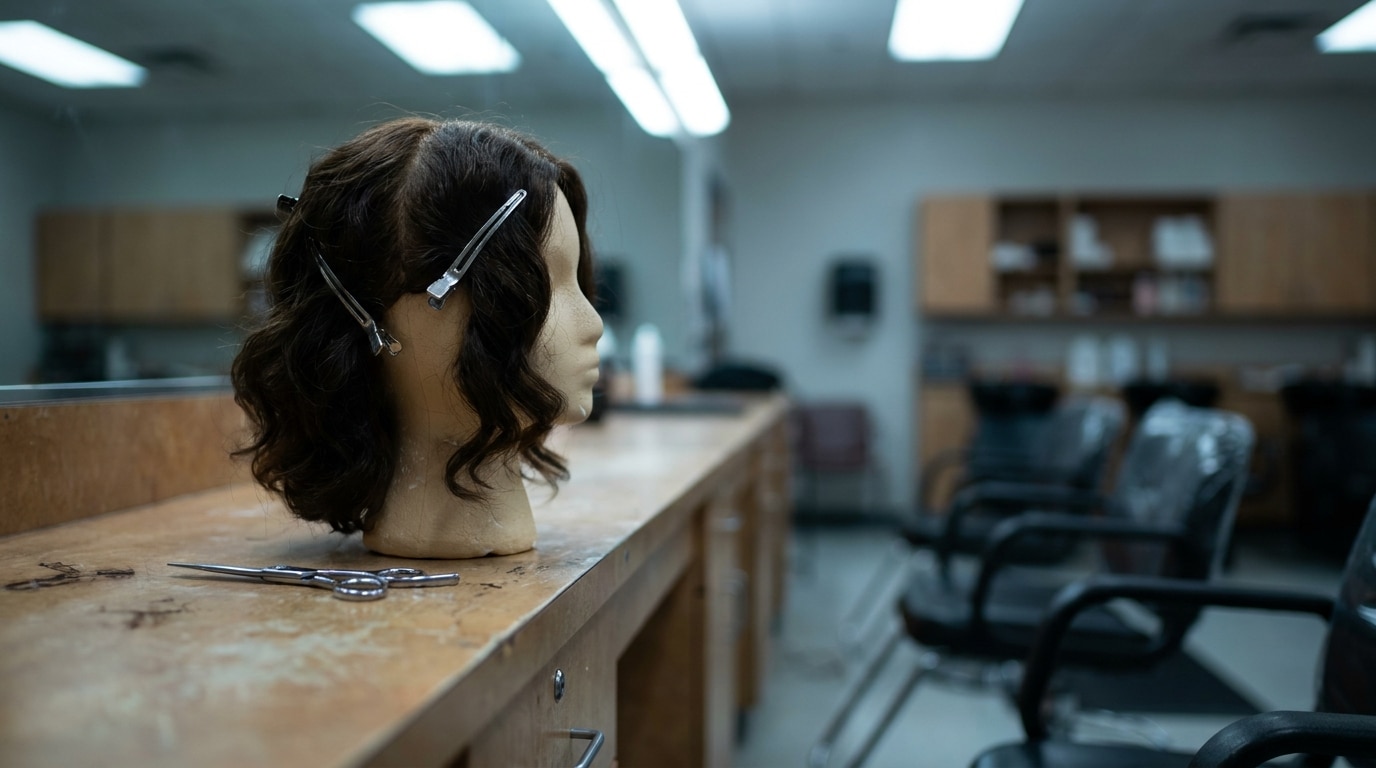
The shortest route is not automatically the best route. Students should compare what they will practice, who supervises them, how the school prepares candidates for state examinations, and whether graduates receive career support.
A private cosmetology school tends to concentrate on licensure and salon skills. A community college may offer similar technical preparation with a lower public-school tuition structure in some areas, though the schedule can be less flexible. An associate degree takes longer because it usually adds general education. That extra study can make sense for a future salon owner, educator, or manager, but it is not necessary for every stylist.
Apprenticeship offers another kind of education. The candidate learns in a working environment under an approved professional. This route can feel more immediate because real salon routines are present from the beginning. Yet apprenticeship rules vary sharply, and the required hours may exceed those of a school program. Availability also depends on finding a qualified participating establishment and supervisor.
What Students Should Compare Before Enrolling
A polished tour and rows of new styling chairs reveal very little about whether a program is worth the investment. Better questions are practical:
- Is the program approved by the relevant state licensing authority?
- How many students finish on time?
- What is included in tuition, and what must be purchased separately?
- How much supervised practice is completed with real clients?
- Does the curriculum cover textured hair, color correction, sanitation, and consultation?
- How does the school prepare students for the state examination?
- Can training hours transfer if the student moves or changes schools?
Accreditation and state approval should not be treated as interchangeable terms. State approval is central to license eligibility. Institutional accreditation may affect financial-aid access or credit transfer, but students should confirm those consequences with the school and relevant agencies before committing.
Training Ends, but Learning Does Not
Passing a licensing exam proves that a new professional has met an entry standard. It does not create speed, judgment, or a loyal client list overnight. Those develop through repetition, feedback, continuing classes, and close attention to what clients actually request.
The career also contains more business than many newcomers expect. The Bureau of Labor Statistics reports that 48 percent of hairdressers, hairstylists, and cosmetologists were self-employed in 2025. Scheduling, pricing, inventory, recordkeeping, marketing, and client retention can become as important as technical creativity. The agency projects employment for hairdressers, hairstylists, and cosmetologists to grow 8 percent from 2025 to 2035, faster than the 3 percent average for all occupations.
That is why a four-year degree can be unnecessary while serious education remains essential. Hairstyling is not a shortcut around learning. It is a decision to learn through a licensed, practice-heavy route. The smartest candidate stops asking only how many years school will take and starts asking what competence, legal eligibility, and working confidence will exist at the end of those years.
The final timeline is personal but not mysterious. Find the state board, identify the correct license, verify the approved path, and calculate the hours against a realistic weekly schedule. College may be part of that plan. For most aspiring hairstylists, however, it does not have to be.